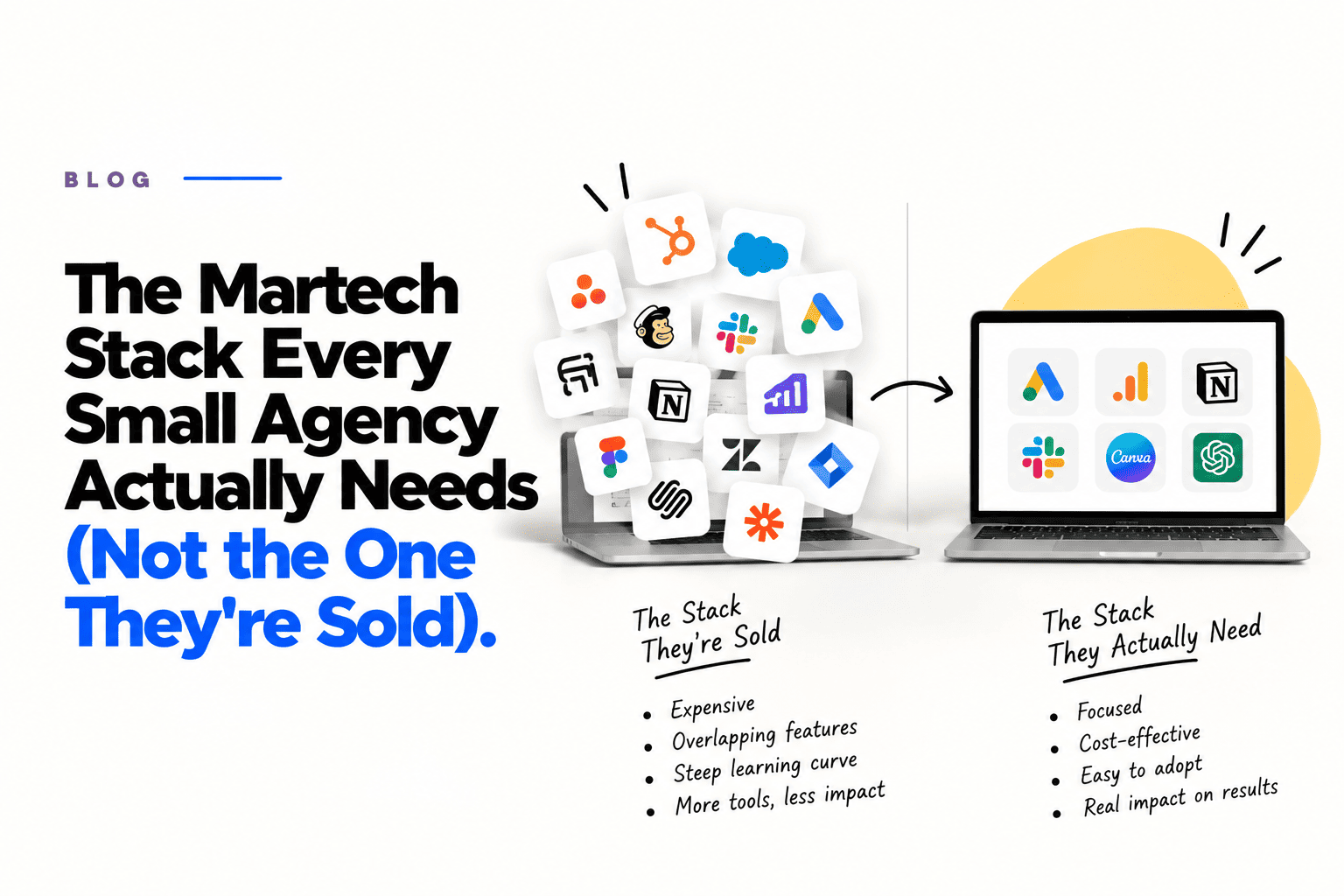
Open the subscriptions list of almost any small agency and you will find the same pattern: three tools that manage projects, two that schedule posts, an AI writer nobody opened last month, and an expensive platform bought for one client who left a year ago.
None of it happened through bad judgement. Each tool was bought for a sensible reason at the time. But together they create cost, confusion and a team that spends more time moving work between systems than doing it. The fix is not a new platform. It is a clear view of the jobs your agency needs done, and one good tool for each.
The lean agency stack at a glance
Tool names are common examples, not endorsements. Choose one tool per layer that fits your team.
// 01 — Industry insightMore tools, less use
The choice keeps growing. Scott Brinker's 2025 marketing technology landscape counted 15,384 solutions, 9% more than the year before. More than 2,400 new tools were added, while about 1,200 disappeared through acquisitions and shutdowns. For a small agency, that is not a menu. It is a maze.
Utilisation keeps falling. Gartner's 2023 martech research found marketers were using only about a third of their stack's capabilities, down from 58% in 2020. Spending rose over the same period. In other words, teams have been paying for more and using less.
AI has added a new layer of promises. In Gartner's October 2025 survey of 413 martech leaders, 81% were piloting or implementing AI agents, yet 45% said vendor-offered agents were not delivering the business performance they had been promised. Half said their data and technical stack was not ready. Adding AI to a messy stack tends to automate the mess.
The best stack is not the one with the most features. It is the one your team actually uses every day.
// 02 — The problemWhy small agencies end up over-tooled
- Demos sell the future. Sales demos show what a tool could do for a mature, well-staffed team. Small agencies buy the vision and use the basics.
- Tools get bought per client. A new client uses a particular platform, so the agency subscribes. The client leaves; the subscription stays.
- Free trials become habits. A trial turns into a paid plan because nobody remembered to cancel, or because one person started relying on it.
- Features overlap quietly. Project tools add chat, chat tools add documents, design tools add scheduling. Soon three tools do the same job.
- Nobody owns the stack. Without one person responsible, tools are added easily and removed rarely.
// 03 — The stackSeven core layers, one rule each
Think in jobs, not tools. Every small agency needs the same seven jobs done. Pick one primary tool per job, and add a rule that keeps it clean.
| Layer | Job it does | Rule that keeps it clean |
|---|---|---|
| Work & communication | Email, files, meetings, internal chat | One place for files; client chat kept separate from team chat |
| Projects & clients | Tasks, deadlines, approvals | If it is not in the project tool, it is not a task |
| CRM & pipeline | Leads, proposals, renewals | Every new business conversation gets logged |
| Create & design | Graphics, video, copy | Shared brand templates for every client |
| Publish & schedule | Posting and approvals | Nothing goes live without a recorded approval |
| Measure & report | Analytics and client reporting | One reporting template, automated where possible |
| Finance & admin | Invoices, payments, contracts | Invoices raised from the same system that tracks projects or CRM |
When to add specialist tools
| Tool type | Add it when… |
|---|---|
| SEO suite | SEO is a paid service for several clients, not a one-off audit |
| Email marketing platform | You run regular campaigns or newsletters for clients |
| Social listening | Clients pay for reputation or trend monitoring |
| Ad management tool | You manage enough ad accounts that native platforms become slow |
| Digital asset library | Finding approved files is costing the team real time every week |
| All-in-one agency platform | Your processes are stable and documented, and you want to consolidate |
// 04 — What to doA six-step stack clean-up
List every subscription
Pull card and bank statements. Note each tool, its cost, who uses it, and when it was last used. The list is usually longer than anyone expects.
Map each tool to a job
Assign every tool to one of the seven layers. Where two tools share a layer, choose one and plan the move.
Cancel what nobody opened last month
If a tool has not been used in thirty days, it is rarely essential. Export anything you need and cancel.
Connect before you add
Before buying something new, check whether your existing tools can be integrated to solve the problem. Many gaps are really missing connections.
Name a stack owner
One person approves new tools, manages access and runs a light quarterly review. It takes an hour a quarter and saves far more.
Train before you buy
Most teams use a fraction of what they already have. An afternoon of training often unlocks more value than a new subscription.
Process first, platform second
A tool cannot fix a process you have not defined. It can only make it faster, including the parts that are broken.
Small agencies often reach for software when they feel growing pains: missed deadlines, messy approvals, slow reporting. The instinct is understandable, but the root cause is usually unclear process, not missing technology. Buying a new platform before agreeing how work should flow simply moves the confusion somewhere more expensive.
The agencies that stay lean tend to follow a simple order: define how work moves from brief to delivery, choose the smallest set of tools that supports it, connect them properly, and only then look at AI and automation to speed things up.
A lean stack also has a quieter benefit. When every client's work lives in the same few places, new team members get productive faster, handovers are cleaner, and the agency can grow without its tools growing faster than its people.
// 05 — Key takeawaysWhat to remember
// 06 — FAQFrequently asked questions
What martech tools does a small marketing agency need?
Most small agencies need seven core layers: work and communication, project and client management, a CRM, content creation and design, publishing and scheduling, analytics and reporting, and finance and admin. Specialist tools can be added as client needs and volume grow.
How many tools should a small agency use?
There is no fixed number, but a good rule is one primary tool per job. If two tools do the same job, or a tool has not been used in the last month, it is usually a candidate to remove.
Should small agencies buy all-in-one agency platforms?
Only once their processes are clear and stable. All-in-one platforms can reduce tool sprawl, but they also lock in workflows. Agencies that adopt them before defining how they work often end up paying for features they never use.
How often should an agency review its martech stack?
A light review every quarter works for most small agencies: list every subscription, who owns it, when it was last used and what job it does, then cancel, consolidate or keep.