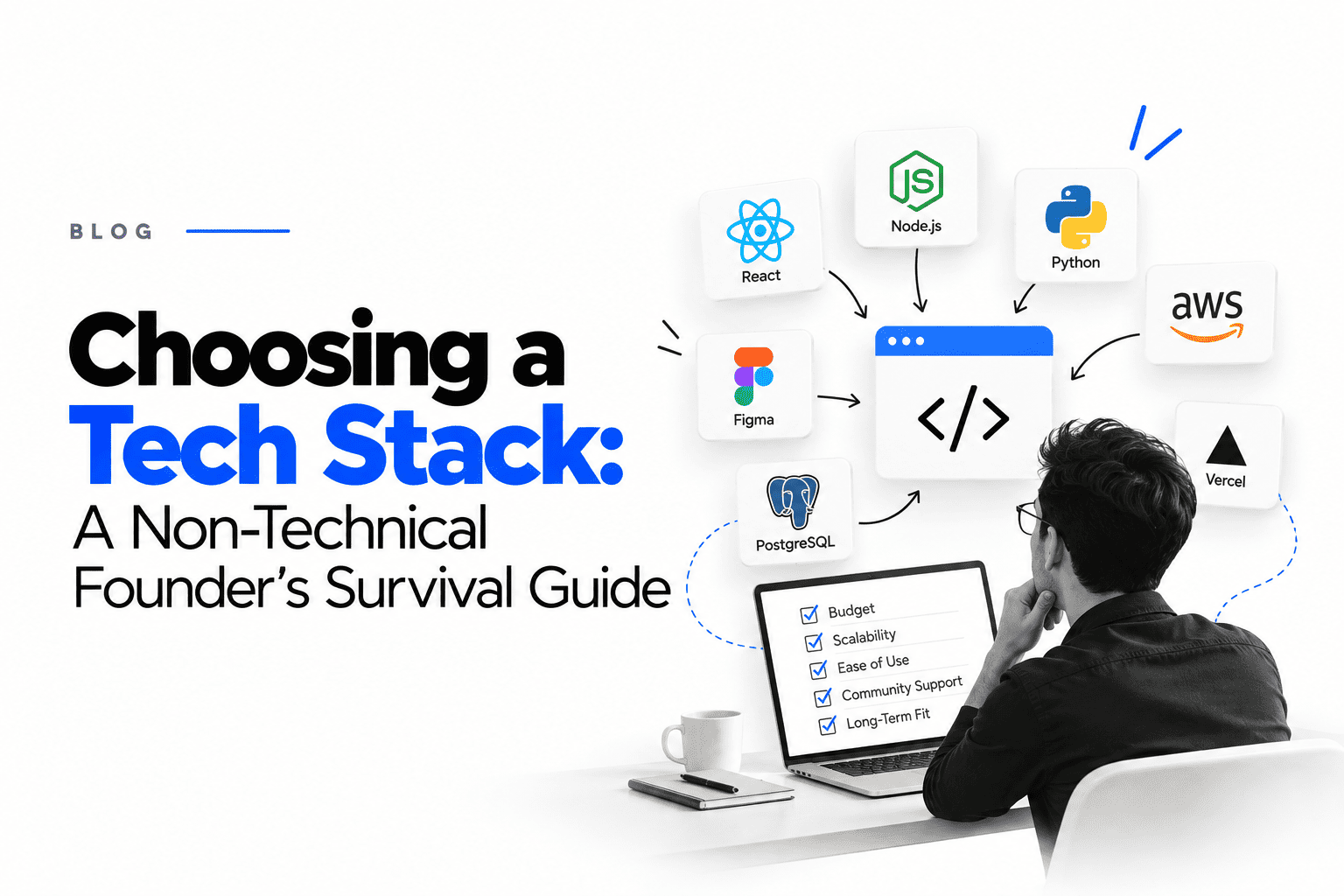
Every non-technical founder eventually sits in a meeting where a developer says something like "we'll use React on the front end, Node on the back end and Postgres for the database", and everyone nods. The decision has been made. The founder just has not realised it yet.
Technology choices made in the first few months of a business tend to stay for years. They affect how fast you can launch, how easily you can hire, how much you pay every month and how painful it is to change direction later. You do not need to become an engineer to get these decisions right. You need a simple mental model, a handful of principles and a list of questions that expose weak answers.
A tech stack, explained like a restaurant
Examples are common options, not recommendations. What matters is how the layers fit your business.
// 01 — Industry insightWhy popular technology is usually the safer choice
Popularity means people. The 2025 Stack Overflow Developer Survey, with responses from more than 49,000 developers, found JavaScript used by 66% of respondents and Python by about 58%. Among databases, PostgreSQL led at around 56%, and among web technologies Node.js and React were the most widely used. For a founder, these numbers matter less as technical trends and more as a hiring signal: the more developers who know a technology, the easier and cheaper it is to find help, replace a departing developer or get a second opinion.
Popularity also means support. Widely used tools have more documentation, more tutorials, more tested libraries and more answers to common problems. Niche or very new tools can be excellent, but when something breaks at 11 pm before a launch, a large community is a practical advantage.
India's talent pool follows the mainstream. Most developers and agencies in India work with the same widely used stacks. Choosing mainstream technology gives an Indian startup far more options for hiring, freelancers and agency partners than choosing something rare.
Choose boring technology for your product, so you can spend your creativity on your customers.
// 02 — By stageThe right stack depends on where you are
| Stage | Goal | Sensible approach |
|---|---|---|
| Idea & validation | Prove people want it | No-code or low-code tools, landing pages, forms and spreadsheets |
| First product (MVP) | Launch something real, quickly | A mainstream, well-supported stack; managed hosting; minimal features |
| Early growth | Improve and add features | Same stack, better testing, monitoring and documentation |
| Scale | Handle more users and data | Optimise the parts that are actually slow; add specialist tools only where needed |
The most common mistake is building for scale before there is anything to scale. Complex architectures designed for millions of users slow down early teams and cost more to run. Most products need to find their first hundred customers long before they need to worry about their first million.
// 03 — The survival kitEight questions to ask any developer or agency
You do not need to judge the technical answer. You need to judge whether the answer is clear, specific and tied to your business.
| Ask | A good answer sounds like | A red flag sounds like |
|---|---|---|
| Why this stack for us? | Linked to our product, budget and hiring | "It's the latest" or "it's what we always use" |
| Who owns the code and accounts? | You, in your company's name, from day one | "We'll host and manage it for you" |
| How easy is it to hire someone else to maintain this? | Common technology, documented code | Rare tools only they understand |
| What will it cost to run each month? | An estimate with clear assumptions | "It depends" with no numbers |
| How are backups and recovery handled? | Automatic backups, tested restores | "We haven't needed that yet" |
| How are security updates managed? | A regular, named process | No plan or owner |
| Can we launch a smaller version first? | Yes, with a clear first scope | Everything must be built at once |
| How will we know it works before customers see it? | Testing, a staging site and monitoring | "We'll test it manually at the end" |
// 04 — What to doSix rules to protect your business
Own every account in the company's name
Domain, hosting, cloud, code repository, app store, payment gateway and analytics accounts should all belong to the business, with developers added as users, not owners.
Favour mainstream, well-supported technology
Choose tools many developers know. It protects you when people leave and keeps hiring and support costs down.
Start smaller than feels comfortable
Build the fewest features that prove the idea. Validate with no-code where you can, and add complexity only when customers ask for it.
Get a written plan for running costs
Ask for expected monthly costs at today's usage and at ten times that. Surprises in cloud bills are common and avoidable.
Insist on documentation and handover notes
A short document explaining how the product is built, deployed and maintained can save months if your developer or agency changes.
Get an independent second opinion
For big decisions, pay an experienced developer or technical advisor for a few hours to review the plan. It is one of the best-value investments a non-technical founder can make.
A founder's job is to own the decisions, not the code
You can outsource the building. You should never outsource the ownership.
Non-technical founders often feel they must either become technical overnight or hand every decision to whoever is building the product. Neither is necessary. The founder's role is to set the goals, understand the trade-offs, ask good questions and make sure the business always controls its own product, data and accounts.
The most painful stories we hear rarely involve the "wrong" programming language. They involve founders locked out of their own hosting, apps built on tools nobody else understands, or monthly bills that grew faster than revenue. All of those are avoidable with a little structure at the start.
Choose widely used technology, start small, own everything and document as you go. That combination will not make headlines, but it will keep your product alive long enough to succeed.
// 05 — Key takeawaysWhat to remember
// 06 — FAQFrequently asked questions
What is a tech stack?
A tech stack is the combination of technologies used to build and run a digital product: the front end users see, the back end that handles logic, the database that stores information, the hosting it runs on and the services it connects to.
Can a non-technical founder choose a tech stack?
Yes. Founders do not need to know how to code, but they should understand the trade-offs, ask the right questions, favour widely used technologies, and make sure the business owns its code, accounts and data.
Should an early-stage startup use no-code tools?
Often, yes, for testing an idea. No-code tools let founders validate demand quickly and cheaply. Once the product is proven and needs custom features or scale, moving to a mainstream coded stack usually makes sense.
What is the biggest tech mistake non-technical founders make?
Letting a developer or agency own the code, hosting and accounts. If the relationship ends, the business can lose access to its own product. All accounts and code repositories should be in the company's name from day one.