
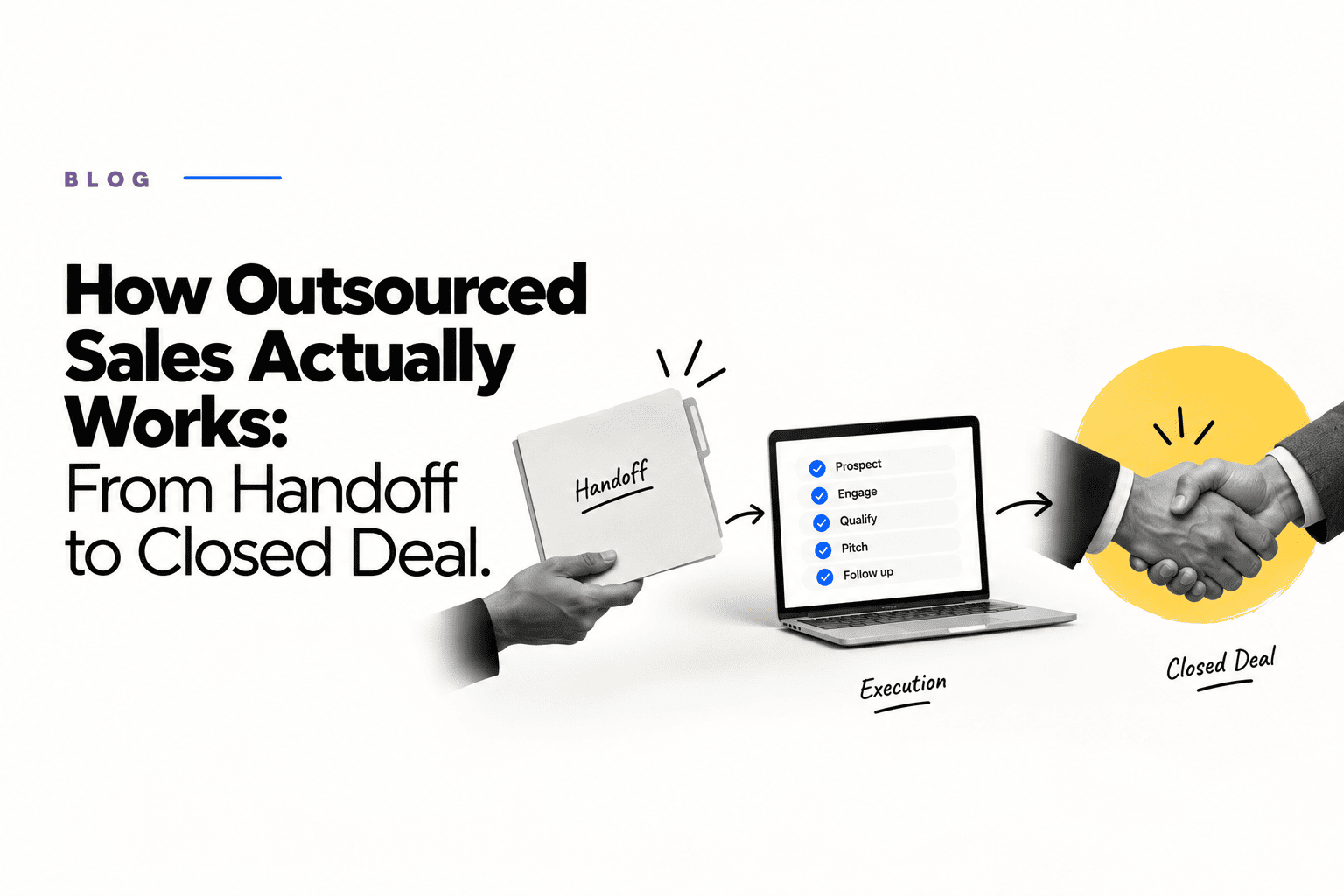
"We'll give you the leads, you close them" is how many people imagine outsourced sales. In practice, a good engagement looks much more like adding a new team to your company: it needs onboarding, shared rules, shared systems and a steady rhythm of review.
When outsourced sales fails, it is rarely because the external team cannot sell. It is usually because something broke between the two organisations: knowledge that was never transferred, a definition nobody agreed on, or a lead that sat untouched after being handed back. Understanding the process end to end is the best protection against all three.
The engagement at a glance
Illustrative timing. Highlighted stages contain the two handoffs where most deals are lost.
// 01 — Industry insightWhy companies outsource sales in the first place
Building in-house takes time and keeps leaking. The Bridge Group's 2025 benchmark of 351 B2B companies found that a new sales development rep takes about three months to ramp up, stays for under two years on average, and that median annual attrition runs at around 40%. The figures skew towards software companies in mature markets, but the pattern is familiar to anyone who has built a sales team in India: hiring, training and replacing people consumes much of the capacity you hired them to create.
Buyers want fewer, better conversations. Gartner's 2026 research found that most B2B buyers prefer to do much of their research without a rep, yet 69% still turn to salespeople to validate what they have learned, particularly when choosing a supplier or getting internal approval. The sales role is becoming more specialised, and specialised capacity is exactly what companies look to partners for.
Outcome-based models reduce the risk. As discussed in Blog 11, more outsourced sales arrangements now tie payment to results. That makes it easier to test a new market, segment or product without committing to a full team up front.
Outsourcing sales is not handing work away. It is adding a team that has to be connected properly.
// 02 — The journeySix stages, from first conversation to closed deal
Fit check
Is this actually outsourceable?
Not every product or market suits an external team. A good partner will ask hard questions before agreeing to anything.
- Is there a clear customer profile and a proven reason to buy?
- Can the outcome be defined and verified?
- Does the sales cycle and deal size justify the model?
Handoff & onboarding
Transfer what your best salesperson knows
This is the first critical handoff. The external team needs the knowledge that normally lives in your founders' and top sellers' heads.
- Ideal customer profile, with real examples of past wins and losses
- Product training, common objections and how they are answered
- Pricing rules, discount limits and what needs approval
- Compliance boundaries: what can and cannot be said or promised
Setup
Build the machine before switching it on
Most avoidable problems are prevented here.
- Target lists built and checked against the customer profile
- Messaging drafted and approved, in the right languages
- Channels chosen: calls, WhatsApp, email, LinkedIn, field visits
- Shared CRM access and a written definition of a "qualified" prospect
Outreach
Start conversations, not just activity
The first weeks of outreach are as much about learning as about selling.
- Multichannel contact with the target list
- Early feedback on which messages and segments respond
- Quick adjustments to lists and messaging based on real conversations
Qualify & close
The second critical handoff, or none at all
What happens here depends on the model you choose.
- Appointment setting: the partner qualifies prospects and hands them to your team, which must follow up fast. This is where many deals are lost.
- Full-cycle: the partner runs presentations, negotiation and closing within limits you set, and hands over a confirmed customer.
- Either way, the outcome is verified against the agreed definition.
Review & improve
Run it like a team, not a vendor
Regular reviews turn a contract into a working partnership.
- Weekly: pipeline, blockers, lead quality and fast fixes
- Monthly: outcomes against targets, cost per outcome, what to scale or stop
- Customer feedback from both new customers and lost prospects
// 03 — ResponsibilitiesWho owns what
Confusion about responsibilities causes more friction than poor performance. A simple split like the one below, agreed in writing, prevents most disputes.
| Area | Client | Sales partner |
|---|---|---|
| Customer profile & positioning | Owns | Refines with feedback |
| Pricing, discounts & approvals | Owns | Works within limits |
| Lists, messaging & outreach | Approves | Owns |
| Qualification against agreed criteria | Audits | Owns |
| Follow-up on handed-over prospects | Owns (appointment model) | Owns (full-cycle model) |
| Delivery, onboarding & service | Owns | Smooth handover |
| Customer & prospect data | Owns | Uses, never keeps |
// 04 — What to doSix things clients should do to make it work
Name one internal owner
One person on your side who answers questions, approves messaging and chases internal follow-up. Engagements with no clear owner drift within weeks.
Share the real story, including losses
Past lost deals, common objections and unhappy customers teach an external team more than any pitch deck. Share them early.
Agree definitions before launch
What is a qualified prospect? What counts as a closed outcome? Write both down and sign off on them before outreach begins.
Work in one shared system
Keep everyone in your CRM or a shared pipeline you control. It prevents lost leads, protects your data and makes reviews honest.
Follow up fast on every handover
If your team closes the deal, respond to handed-over prospects quickly. Slow follow-up wastes the partner's work and the buyer's interest.
Set realistic timelines
Expect setup in weeks, early signals soon after launch and steady results over a few months, depending on your sales cycle. Judge the partner on trends, not the first fortnight.
You can outsource the selling. You cannot outsource the responsibility.
The best outsourced sales teams stop feeling outsourced within a month.
In our experience, the difference between engagements that work and those that do not is rarely the partner's talent. It is how seriously the client treats the connection points: onboarding, shared definitions, shared data and fast follow-up. When those are done well, the external team behaves like an extension of the business. When they are not, even excellent salespeople end up working blind.
We also think clients should hold partners to a high standard of transparency. You should be able to see every conversation, every prospect and every stage in a system you own. A partner who resists that openness is asking you to trust results you cannot verify.
Handled well, outsourced sales gives a growing company something rare: experienced sales capacity that can start quickly, scale with results and plug into the business without the long ramp and high churn of building every seat from scratch.
Disclosure: Digixon operates an outcome-based sales practice. This article reflects our view of the industry, not a recommendation of any provider.
// 05 — Key takeawaysWhat to remember
// 06 — FAQFrequently asked questions
How long does it take for outsourced sales to show results?
Onboarding and setup usually take a few weeks. Early conversations and qualified prospects can appear soon after launch, but closed deals depend on the sales cycle. For short-cycle sales this may be weeks; for complex B2B deals it can be several months.
What is the difference between appointment setting and full-cycle outsourced sales?
In appointment setting, the partner finds and qualifies prospects, then hands them to the client's own team to close. In full-cycle outsourcing, the partner also runs the later stages, including presentations, negotiation and closing, within limits the client sets.
Who owns the customer data in an outsourced sales engagement?
It should be the client. The contract should state that all prospect and customer data belongs to the client, and ideally the partner works inside the client's CRM or a shared system the client controls.
How should companies measure an outsourced sales partner?
Measure the agreed business outcome first, then supporting indicators such as conversation quality, conversion between stages, lead acceptance rate by the client's team and customer feedback. Activity volume alone is a weak measure.